




Which States Restrict Online Gun and Ammo Sales, and What Changes at Checkout?
Which states restrict online gun and ammo sales? A hub for online sellers: California, New York, Massachusetts, and Colorado rules, how state law reaches federal dealers, and what changes at checkout.
Giancarlo Byrne
11/17/2026
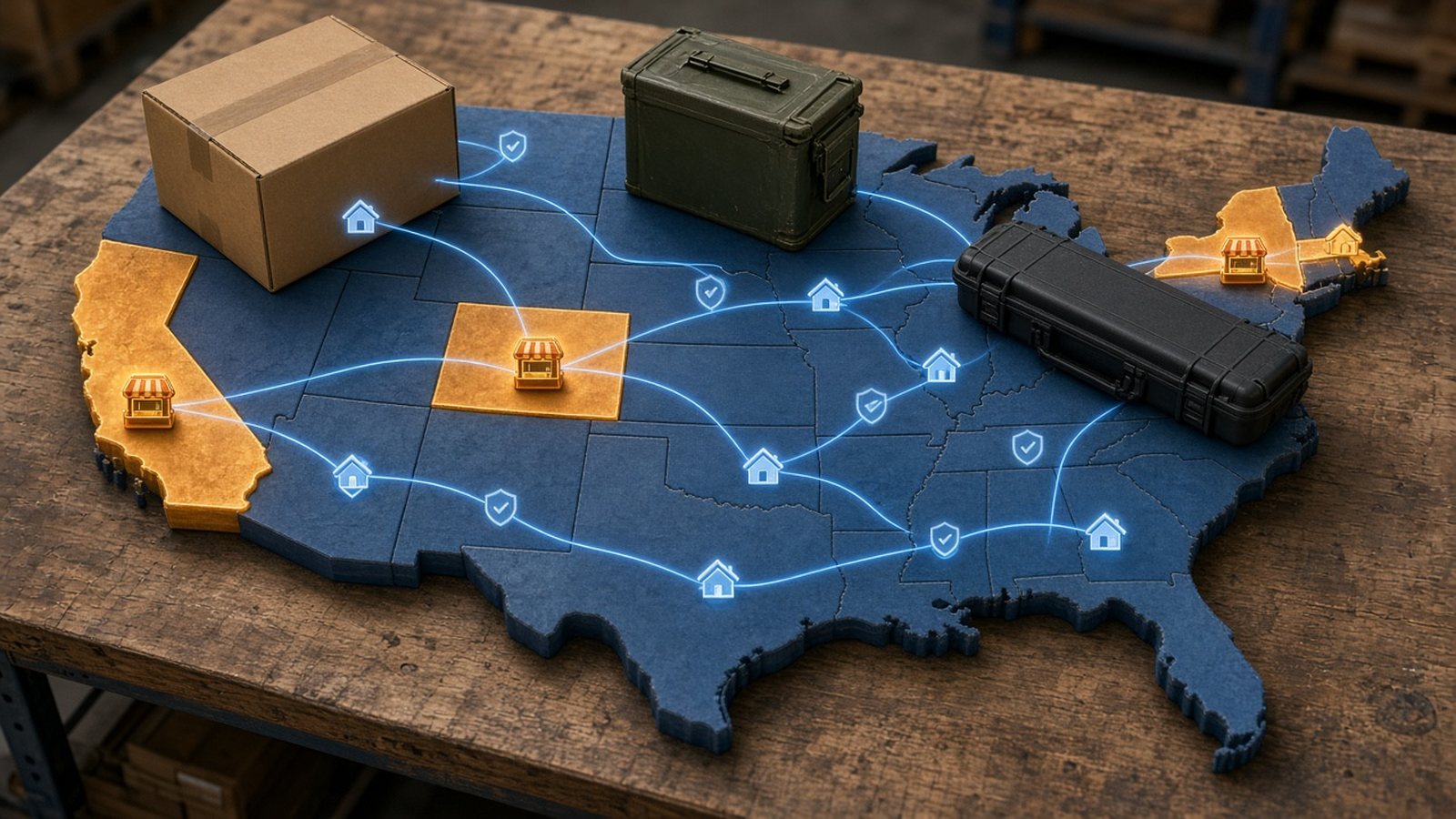
Which states restrict online gun and ammo sales, and what changes at checkout? The short version: federal law sets the floor, and every state can add to it. For firearms, the biggest state rules usually land on the dealer who receives the gun. For ammo, a handful of states, including California, New York, and Massachusetts, effectively take the buyer’s front door off the table, so the order has to go to a licensed seller instead. Colorado now goes further than most and treats some receivers and parts kits as covered firearms. This post is a hub for those rules, with links to our deeper posts on each one.
This is the eleventh post in our getting-started series on selling firearms and ammo online. The last two covered shipping firearms and shipping ammunition. This is general education, not legal advice. State laws change often, and some are in active litigation, so check the current statute and talk with a firearms attorney about your own store.
Why state law matters to a federal licensee
The Gun Control Act ties federal dealers to state law directly. Under 18 U.S.C. 922(b)(2), a licensee may not sell a firearm or ammunition to someone when the purchase or possession would violate state law, or a published local ordinance, at the place of sale, delivery, or other disposition. So a sale can be fine under federal rules and still be a problem because of where it’s going.
That’s why “ship to the buyer” is never one rule for the whole country. The destination state decides a lot of it.
Firearms: the dealer step does most of the work
For a typical online firearm sale, the gun already goes to a licensed dealer near the buyer, who runs the Form 4473 and background check. Our post on how FFL dealer selection works at checkout explains why. That federal routing is also where most state firearm rules get applied, because the receiving dealer has to follow its own state’s process before handing anything over.
A few state rules we’ve covered that affect what you sell or how the transfer happens:
- Colorado dealer transfer log. Colorado dealers keep a state transaction log for transfers. See our HB26-1126 post.
- Connecticut convertible pistols. A court order put one part of the state’s 2026 law on hold. See Connecticut’s convertible pistol ban.
- California magazines. California restricts large-capacity magazines under Penal Code section 32310. That’s a product question, not just a shipping question.
- New Mexico waiting period. New Mexico’s 7-day waiting period law is being challenged in NSSF v. Torrez. Check the current status before you change anything for New Mexico orders.
Colorado: receivers and parts kits count too
Colorado’s SB25-003, codified at C.R.S. 18-12-116, took effect August 1, 2026. It bars selling or buying a “specified semiautomatic firearm” unless the buyer has completed the required safety course within the last five years. Covered firearms include semiautomatic rifles and shotguns with detachable magazines and gas-operated semiautomatic handguns with detachable magazines. A federal court denied a preliminary injunction on November 4, so the law is in force.
Two details matter for online sellers:
- Frames, receivers, and parts kits. The Colorado Firearms Dealer Division’s July 30, 2026 guidance says frames or receivers and weapons parts kits for these firearms fall within the definition themselves. Colorado also defines “frame or receiver” by function, not by ATF’s definition: a part visible from the outside that houses or holds a fire control component. The list of those components includes the hammer, bolt, bolt carrier, trigger mechanism, firing pin, and striker (C.R.S. 18-12-101).
- The FFL exemption. Transfers to a federally licensed dealer, and to people who live in another state, are exempt. The buyer gets an eligibility card through the state’s Firearms Safety System, and the Colorado dealer confirms it before the background check (Colorado Parks and Wildlife).
So if you ship covered rifles, stripped lowers, or parts kits to Colorado buyers, the path that fits the law’s own exemption is shipping to a Colorado dealer. One open question: whether an AR-style upper receiver counts. The state hasn’t named uppers in anything we’ve seen, but its functional definition lists the bolt and bolt carrier. Dealers can ask the Division for a Statement of Position, and that’s worth doing, along with a talk with your attorney, before you ship uppers to Colorado doors.
Ammo: where the front door is off the table
Ammo is where state rules change checkout the most, because federal law lets most ammo ship to a home address. These states change that:
- California. Ammo sales must go through a licensed ammunition vendor, and internet orders must be delivered to a vendor and processed face to face (Penal Code section 30312).
- New York. “No commercial transfer of ammunition shall take place unless a licensed dealer in firearms or registered seller of ammunition acts as an intermediary,” and the transfer must happen in person (Penal Law section 400.03). Our posts on shipping ammo to California and New York and New York’s October ammo changes go deeper.
- Massachusetts. A Massachusetts licensee can’t fill a mail, phone, or internet order for a firearm or ammunition unless the buyer presents the required license in person before delivery (M.G.L. c.140 section 123). The state’s “ammunition” definition also includes primers, powder, bullets, and cartridge cases (section 121). Our ammo shipping post covers the open questions.
- Colorado. HB25-1133, effective July 1, 2026, covers out-of-state online ammo sellers shipping into Colorado and requires age-verified delivery, generally to someone 21 or older, with a written acknowledgment of receipt (bill page).
- DC and U.S. territories. See ammo-to-FFL routing for DC and U.S. territories.
Other states, such as Illinois and New Jersey, have their own permit or ID rules for ammo buyers. We haven’t covered those yet, so read the statute before you set rules for them. Cities and counties can add rules too, and this post doesn’t cover local ordinances.
What changes at checkout
State rules show up at checkout in three places:
- Where the order ships. For restricted states, the ship-to address becomes a dealer or licensed seller, not the buyer’s home.
- Which products you list. Some items, like California large-capacity magazines, are a catalog decision for certain states, not a routing decision.
- What you confirm before shipping. Age, the receiving dealer’s state licensing, and whether that dealer will accept the order. Call first; an active federal license doesn’t mean a dealer takes transfers or ammo orders.
Where Automatic FFL fits
Automatic FFL handles the routing step. For ammo, you choose the states where ammo should go to a dealer, and you mark your ammo products by category (or with the ffl_type custom field set to ammo on BigCommerce). Customers shipping ammo to a state you picked choose a dealer from the map at checkout, and that dealer becomes the shipping address. Ammo going to other states can still ship to the customer.
For products you mark as FFL-required (the ffl_type field on BigCommerce, the “FFL Required” option on WooCommerce, or the “FFL Required” attribute on Magento), the buyer picks a dealer at checkout and the item ships there. That works on BigCommerce, WooCommerce, and Adobe Commerce / Magento. Shopify is ammunition only.
Automatic FFL doesn’t decide which states or products need these rules, check buyer age, or confirm a dealer’s state license. Those decisions stay with your store and your attorney.
Try it on your store
Look up a transfer dealer for free. Create a free Automatic FFL account to search FFL dealers by license number, name, city, state, or ZIP, open each dealer’s ATF eZ Check record, and see which dealers have certificate data on file. Start with the FFL database. The database is not legal advice and does not replace your own compliance review.
Try Automatic FFL free for 30 days. Add state-based ammo routing and FFL dealer selection to your BigCommerce, WooCommerce, or Adobe Commerce / Magento checkout (Shopify: ammunition only). You’re not charged until the trial ends, and you can cancel before then. Plans start at $99 per site per month after the trial (pricing).
- Start your BigCommerce trial
- Start your WooCommerce trial
- Start your Adobe Commerce / Magento trial
- Start your Shopify ammo trial
Sources: 18 U.S.C. 922; C.R.S. 18-12-101; Colorado SB25-003; Colorado Firearms Dealer Division Bulletin 26-01; Colorado HB25-1133; Cal. Penal Code 30312 and 32310; N.Y. Penal Law 400.03; M.G.L. c.140 section 121 and section 123; Automatic FFL documentation.