




How Do You Ship Ammunition Legally, and Which Carriers Take It?
How do you ship ammunition legally, and which carriers take it? USPS, UPS, and FedEx ammo rules, DOT limited-quantity packaging, age limits, and the states where ammo goes to a dealer.
Giancarlo Byrne
11/16/2026
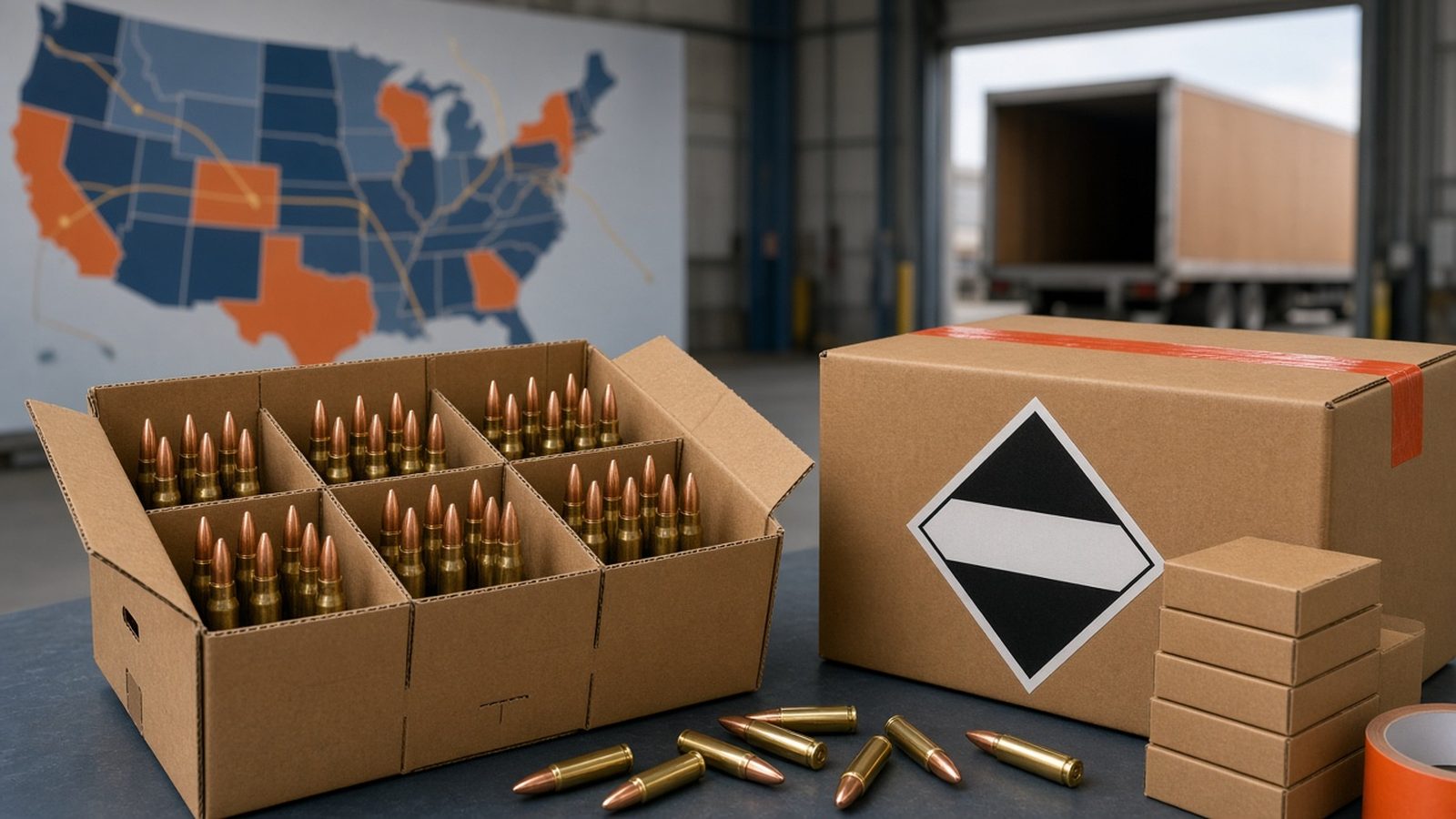
How do you ship ammunition legally, and which carriers take it? For an online ammo store, the short answer is this: USPS won’t carry it, UPS takes it by Ground under its limited-quantity rules, and FedEx takes it only under its dangerous goods rules and never from a retail counter. On top of the carrier rules, you have federal age limits and a growing list of states where ammo can’t go straight to the buyer’s door. This post walks through each layer.
This is the tenth post in our getting-started series on selling firearms and ammo online. The last post covered how to ship a firearm with USPS, UPS, or FedEx. Ammo has its own rules, because carriers treat it as a hazardous material. This is general education, not legal advice. Carrier terms and state laws change, so check the current versions and talk with a firearms attorney about your own store.
USPS: ammunition is not mailable
USPS Publication 52 lists small arms ammunition as a nonmailable explosive. Section 341.22 says ammunition designed to be fired from a pistol, revolver, rifle, or shotgun, along with primers, blank cartridges, and propellant powder for use in any firearm, “is prohibited from mailing” (Pub 52, section 341).
So if your store ships long guns by USPS, the ammo in the same order has to go another way. Pub 52 does note that empty shotgun hulls and empty casings without primers aren’t hazardous materials, so they’re mailable under the normal rules.
What “limited quantity” means
Most small arms ammo ships under a DOT exception for “Cartridges, small arms.” Under 49 CFR 173.63(b), that covers rifle and pistol cartridges up to 12.7 mm (.50 caliber) and shotgun shells up to 8 gauge, packed in inside boxes or partitions, with a maximum of 30 kg (66 lb) per package. Packages shipped this way are called “limited quantity.” Carriers build their ammo rules on this exception, so it’s the term to use with your carrier rep.
Ammo outside that exception, or ammo shipped by other services, is fully regulated hazmat. That takes a carrier contract and hazmat training, and it’s outside the scope of this post.
UPS: Ground only, with a few hard limits
UPS has a dedicated ammunition page (UPS: How to Ship Ammunition). The key rules:
- Service. Limited-quantity ammo ships by UPS Ground only, within the 48 contiguous states, plus UPS Ground Intra-Oahu and Intra-Alaska. Other services require a contract and full hazmat preparation. Ammo isn’t accepted for international shipment.
- Not with firearms. Ammunition may not be packed with a firearm.
- Age. Ammunition may not be shipped to anyone under 18.
- Packaging. New corrugated boxes that meet UPS single-wall strength guidelines, with ammo in inside boxes, partitions, or metal clips that fit snugly. Max 66 lb per package.
- Marking. Each package needs the black-and-white Limited Quantity diamond mark, about 4 by 4 inches.
- How it gets to UPS. Through a UPS scheduled pickup account or a UPS Customer Center counter. Not through drop boxes, The UPS Store, or other retail or Access Point locations.
- Cost. UPS says only standard shipping charges apply to limited-quantity Ground ammo, with no accessorial charges.
UPS also says the shipper is responsible for following all federal, state, and local laws that apply to the shipper, recipient, and package, including age limits. In other words, UPS moves the box. Whether that box may go to that address is your call.
FedEx: dangerous goods rules, no retail drop-off
FedEx’s public firearms page is clear on one point: ammunition is a dangerous good and “may never be shipped from a FedEx Office or other FedEx associated retail location” (FedEx: How to Ship Firearms). It also says firearms can’t ship with ammunition. For the rest of the FedEx ammo rules, FedEx points shippers to its dangerous goods support line. Call it, or ask your FedEx account executive, before you build FedEx into your ammo shipping.
Federal age limits
For licensed dealers, 18 U.S.C. 922(b)(1) sets the floor: 18 for shotgun and rifle ammunition, and 21 for other ammunition. Section 922(e) also requires written notice to the carrier when a firearm or ammunition is shipped to someone other than a licensee. How these rules apply to a store that sells ammo without a license is a question for your attorney. Don’t assume a general answer.
State rules: where ammo can’t go to the door
Carrier rules tell you how to ship. State law can decide whether you ship to the buyer at all. A few examples we’ve covered:
- California and New York. In California, ammo sales go through a licensed ammunition vendor. In New York, a dealer or registered seller does the check in person. See Shipping Ammo to California and New York: What Changes at Checkout? and our post on New York’s October ammo changes.
- DC and U.S. territories. See ammo-to-FFL routing for DC and U.S. territories.
- Massachusetts. On November 3, voters kept the state’s 2024 gun law (Chapter 135) when Question 9 passed, per Ballotpedia and WBUR. Results are unofficial until certified. Under M.G.L. c.140 section 123(k), a Massachusetts licensee can’t fill a mail, phone, or internet order for a firearm or ammunition unless the buyer presents the required license in person before delivery. Transactions between federally licensed dealers are exempt.
Two Massachusetts details trip up online sellers. First, the state’s definition of “ammunition” in section 121 includes cartridge cases, primers, bullets, and propellant powder, not just loaded rounds. If you sell reloading components, ask your attorney whether those products belong in your Massachusetts rules too. Second, whether Massachusetts’s seller license statute reaches an out-of-state store shipping direct to a consumer hasn’t been settled by any case we found. Treat it as legal risk, not a clear answer either way. The cautious path many sellers take is shipping Massachusetts ammo orders to a Massachusetts dealer, where the buyer shows a state license in person. Confirm with that dealer that it holds its state license and will accept the order.
An ammo shipping routine
- Check the destination state. If it’s one you route to a dealer, ship to the dealer the buyer chose, not the home address.
- Confirm the buyer’s age meets the federal floor and any state rule for that product.
- Pack ammo by itself, never with a firearm, in a new corrugated box with inside boxes or partitions. Keep it under 66 lb.
- Apply the Limited Quantity diamond mark.
- Ship by UPS Ground within the 48 contiguous states, or by FedEx under its dangerous goods rules. Never use USPS.
- Tender it through a scheduled pickup or a carrier counter, not a drop box or retail store.
- Keep the tracking number with the order.
Where Automatic FFL fits
Automatic FFL handles the routing step at checkout. You choose the states where ammo should go to a dealer. In the Automatic FFL admin, you check those states in the Ammo settings and mark your ammo products by category, or on BigCommerce with the product custom field ffl_type set to ammo. Customers shipping ammo to a state you selected pick a dealer from the map at checkout, and that dealer becomes the shipping address. Ammo going to other states can still ship to the customer. It works on BigCommerce, WooCommerce, and Adobe Commerce / Magento, and on Shopify for ammunition only.
Automatic FFL doesn’t decide which states need this, check buyer age, or book your carrier. Those stay with your store and your attorney.
Try it on your store
Look up a transfer dealer for free. Create a free Automatic FFL account to search FFL dealers by license number, name, city, state, or ZIP, open each dealer’s ATF eZ Check record, and see which dealers have certificate data on file. Start with the FFL database. The database is not legal advice and does not replace your own compliance review.
Try Automatic FFL free for 30 days. Add state-based ammo routing and dealer selection to your BigCommerce, WooCommerce, or Adobe Commerce / Magento checkout (Shopify: ammunition only). You’re not charged until the trial ends, and you can cancel before then. Plans start at $99 per site per month after the trial (pricing).
- Start your BigCommerce trial
- Start your WooCommerce trial
- Start your Adobe Commerce / Magento trial
- Start your Shopify ammo trial
Sources: USPS Publication 52, section 341; eCFR 49 CFR 173.63; UPS: How to Ship Ammunition; FedEx: How to Ship Firearms; 18 U.S.C. 922; M.G.L. c.140 section 121 and section 123; Ballotpedia: Massachusetts Question 9; Automatic FFL documentation.