




What Does Maryland's 2027 Ban on 'Convertible' Handguns Mean for Online Gun Stores?
Maryland’s SB 334 bans sales and transfers of ‘machine gun convertible’ pistols starting Jan. 1, 2027. No court has blocked it. What online sellers shipping handguns to Maryland should check now.
Giancarlo Byrne
11/26/2026
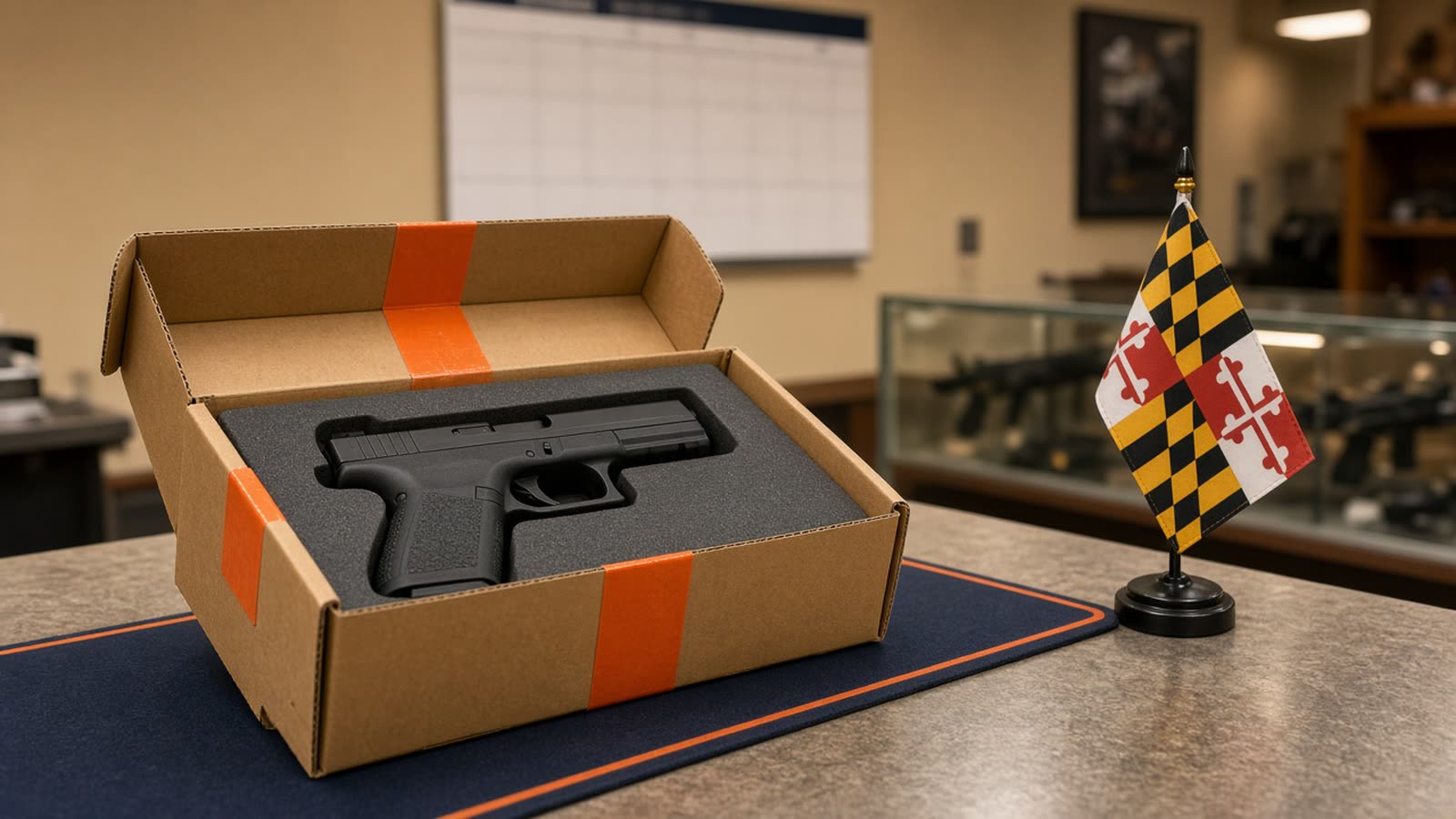
What does Maryland’s new ban on “machine gun convertible” pistols mean for online gun stores that ship handguns to Maryland dealers? Starting January 1, 2027, Maryland law will bar anyone from manufacturing, selling, offering for sale, purchasing, receiving, or transferring a pistol that meets the law’s definition. A federal lawsuit was filed on November 20, 2026, and a motion for a preliminary injunction is pending. As of today, no court has blocked the law.
That leaves about five weeks. This post covers what the law says, what it leaves unclear, and what sellers can do now. It’s general information, not legal advice. If Maryland is a real market for your handguns, review your plan with a firearms attorney.
What SB 334 says
Senate Bill 334 was signed by Governor Wes Moore on May 26, 2026, as Chapter 771. The Act took effect October 1, 2026, but the sales ban in new Criminal Law § 4-305.2 starts January 1, 2027.
The chapter text defines a “machine gun convertible pistol” as a semiautomatic pistol with a cruciform trigger bar that “can be readily converted by hand or by using common household tools into a machine gun” by installing a “pistol converter” in place of the slide’s backplate. A few related points:
- A cruciform trigger bar is a part that links the trigger and the firing pin and “has its sear incorporated into a cross-shaped surface.”
- The definition still applies if the frame has a tab or other blocking material, as long as that material “can be readily removed with a common household tool.” The law lists tools like a screwdriver, pliers, a hacksaw, an electric drill, and a file.
- It does not include hammer-fired pistols or striker-fired pistols without a cruciform trigger bar.
Violations fall under the existing penalty in § 4-306: a misdemeanor with up to 3 years in prison, a $5,000 fine, or both, according to the Department of Legislative Services fiscal note.
What it doesn’t ban
The banned acts are manufacturing, selling, offering, purchasing, receiving, and transferring. Possession is not on that list. AmmoLand reports that the Maryland Attorney General’s Office confirmed existing owners may keep their pistols.
The law also lists exceptions. They include transfers to immediate family members, inheritance, temporary transfers to a dealer or gunsmith for servicing, surrender to police or a dealer, and sales to current or qualifying retired law enforcement officials. Maryland dealers can still sell covered pistols to a licensed dealer in another state, or to an out-of-state buyer through a licensed dealer.
None of those exceptions covers a routine retail sale to a Maryland resident. Starting January 1, the law would bar a Maryland dealer from receiving or transferring a covered pistol for an ordinary customer, unless an exception applies.
Which models are covered? Unclear for now
The law doesn’t name models. It requires the Department of State Police to adopt regulations and publish a list of prohibited pistols, which the State Police’s legislative summary also notes. According to the fiscal note, the State Police reported more than 5,000 models on Maryland’s handgun roster and said at least half of them would need to be evaluated.
We couldn’t find a published list as of November 26. Until one exists, don’t guess. Read the definition, check each model’s trigger design with the manufacturer, and ask your attorney. Watch the Maryland State Police banned firearms page for updates.
Where the lawsuit stands
On November 20, NSSF and several industry members filed suit in federal court in Maryland (NSSF v. Brown, No. 1:26-cv-04844). On November 23, NSSF filed a motion for a preliminary injunction. No ruling has been reported.
This is not the first challenge. AmmoLand reports that in a separate case, Bathras v. Moore, a federal judge denied preliminary injunctions on September 25, 2026. That was not a final ruling on the merits.
Connecticut’s similar law went differently. A court put part of it on hold before it took effect, as we covered in Connecticut’s convertible pistol ban. Each case is separate. Plan for January 1 as written, and adjust if a court acts.
What federal law still requires
Nothing in SB 334 changes federal rules. An interstate handgun sale still goes through a licensed dealer in the buyer’s state, who completes the Form 4473 and the background check. Federal law also bars a licensee from selling a firearm where the sale or possession would violate state law at the place of sale or delivery (18 U.S.C. 922(b)).
The Fifth Circuit’s Elite Precision ruling did not change this nationwide. See our post on that ruling.
A checklist for online sellers
- List your Maryland-bound handgun SKUs. Flag every semiautomatic pistol you ship to Maryland dealers. Hammer-fired models are excluded, but confirm the trigger design of each striker-fired model with the manufacturer.
- Set a cutoff in your restriction rules. An order placed in December may not reach the dealer and transfer before January 1. Pick a date that leaves room for shipping and the transfer. After it, stop selling flagged SKUs to Maryland unless your attorney says otherwise.
- Talk to your Maryland receiving dealers. Ask what they’ll accept after January 1, what they’ll do with in-transit guns, and their last receiving date. Many will set their own policies.
- Plan for stranded orders. Decide now what happens if a transfer can’t finish in time: a refund, a return, or a different product.
- Ask about your listings. “Offer for sale” is a banned act. The law doesn’t spell out how that applies to an out-of-state store’s listing. Your attorney can tell you whether to hide or relabel products for Maryland shoppers.
- Watch the docket and the State Police. Check NSSF v. Brown for a ruling and the State Police for the list.
- Keep records. Save dates, dealer emails, and settings changes so you can show what you did and when.
For other state rules, see our state restrictions hub. Court orders can also change state rules quickly, as with New Mexico’s waiting period.
Where Automatic FFL fits
Automatic FFL handles dealer selection at checkout. When an order needs to go to a licensed dealer, the buyer picks one from a map and list, and the dealer’s license details are added to the order. Merchants set and update their own state restriction rules and product settings. Automatic FFL doesn’t detect state law, decide which products are legal in which states, or make a store compliant. See how FFL dealer selection works at checkout.
Try it on your store
Look up a transfer dealer for free. Create a free Automatic FFL account to search FFL dealers by license number, name, city, state, or ZIP, open each dealer’s ATF eZ Check record, and see which dealers have certificate data on file. Start with the FFL database. The database is not legal advice and does not replace your own compliance review.
Try Automatic FFL free for 30 days. Add FFL dealer selection to your BigCommerce, WooCommerce, or Adobe Commerce / Magento checkout (Shopify: ammunition only). You’re not charged until the trial ends, and you can cancel before then. Plans start at $99 per site per month after the trial (pricing).
- Start your BigCommerce trial
- Start your WooCommerce trial
- Start your Adobe Commerce / Magento trial
- Start your Shopify ammo trial
Sources: SB 334 bill page (Maryland General Assembly); Chapter 771 text; Fiscal and Policy Note; Attorney General’s bill review letter, May 6, 2026; Maryland State Police 2026 legislation summary; NSSF, Nov. 20, 2026; NSSF, Nov. 23, 2026; AmmoLand, Nov. 23, 2026; 18 U.S.C. 922.
This article is general information, not legal advice. Laws, regulations, and court orders can change quickly. Check the current docket and consult a firearms attorney before changing what you sell, advertise, or ship to Maryland.