




What Records Does an Online FFL Have to Keep? The 4473, the A&D Book, and Retention
What records does an online FFL have to keep? A plain guide to the Form 4473, the A&D bound book, entry deadlines, and how long federal rules say to keep them, with what changes when you ship to another dealer.
Giancarlo Byrne
11/18/2026
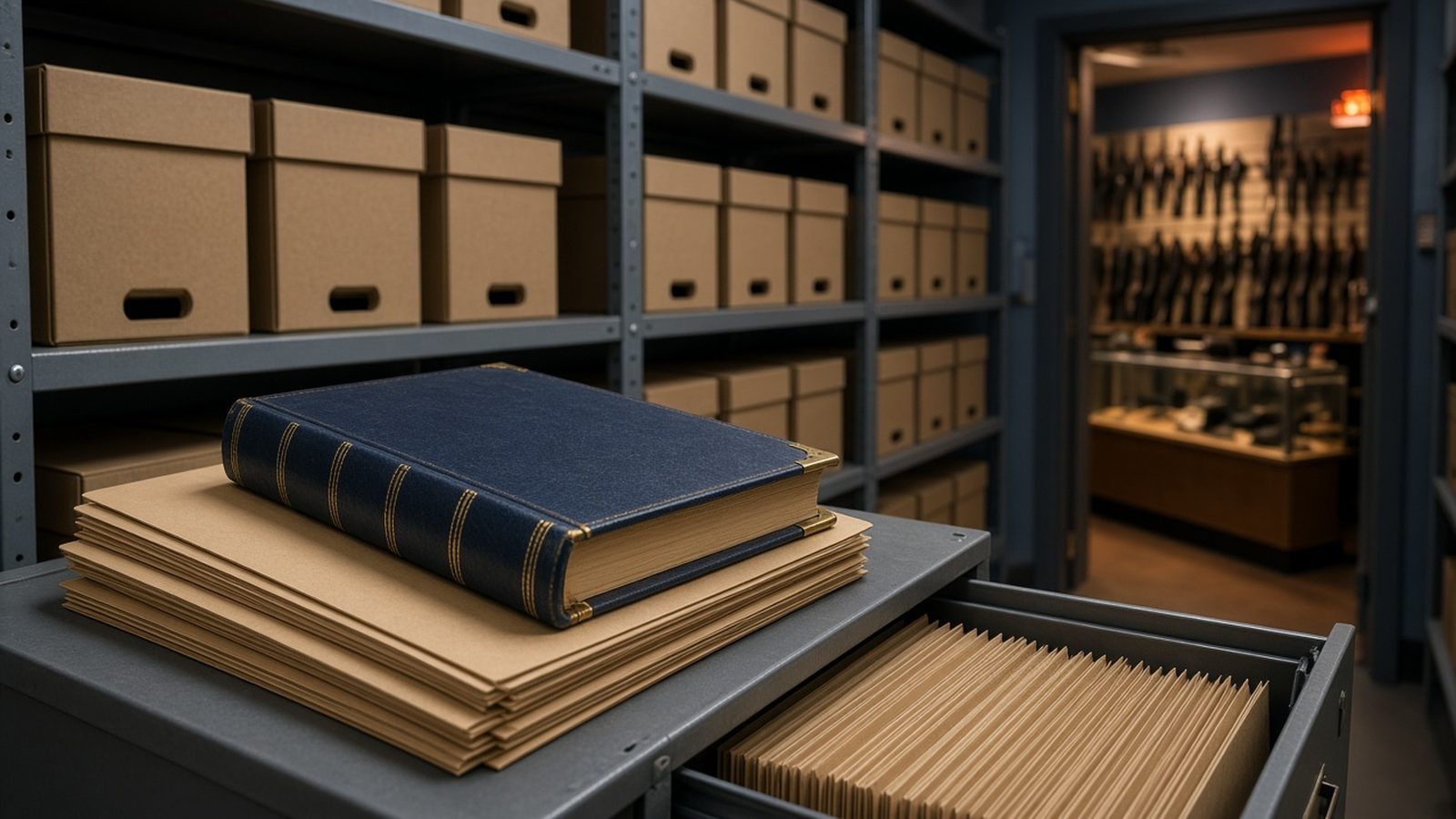
What records does an online FFL have to keep? Under federal rules, the core set is the Form 4473 for every firearm transfer to a non-licensee, the acquisition and disposition (A&D) record, often called the bound book, for every firearm you receive and send out, and a short list of reports like multiple handgun sales. You keep the 4473s and the A&D record until your business or licensed activity ends. Selling online doesn’t add a separate federal record, but it does change which records you create on a given order.
This is the twelfth post in our getting-started series on selling firearms and ammo online. It’s general education, not legal advice. Confirm your own setup with your ATF Industry Operations Investigator (IOI) or a firearms attorney.
The Form 4473: when you need one
27 CFR 478.124(a) says a licensed dealer can’t sell or otherwise dispose of a firearm to anyone other than another licensee without recording it on a Form 4473. The buyer fills out their section, you check their ID, run the NICS check, record the result, and list the gun’s details on the form.
Two exceptions matter for online stores:
- Transfers to another licensee don’t use a 4473. The same section says the form “shall not be used” when the transfer is to another licensed importer, manufacturer, or dealer. Instead, you follow the license verification rules in 478.94. Our post on how to verify an FFL before you ship covers that step.
- Repair returns. A gun you took in only for repair or customizing, then returned to the same person, doesn’t need a 4473.
You file completed 4473s in alphabetical, chronological, or numerical order. Forms for transfers that didn’t happen, such as a denied or abandoned sale, are kept separately in alphabetical or chronological order.
The A&D record (bound book)
27 CFR 478.125(e) requires every licensed dealer to record each receipt and disposition of firearms. Before you start selling, you inventory the firearms you already have for the business and log them as your opening entries.
The deadlines are short:
- Acquisitions: by the close of the next business day after you receive the gun.
- Dispositions: within seven days after the transaction.
Each acquisition entry shows the date, who you got it from (name and address, or name and license number for a licensee), and the gun’s manufacturer, importer if any, model, serial number, type, and caliber or gauge. Each disposition entry shows the date and who received it: the name and address of a non-licensee, the name and license number of a licensee, or the 4473 transaction number if you number and file your 4473s that way.
The regulation says the record is kept “in bound form.” ATF also allows electronic A&D records under ATF Ruling 2016-1, as long as the system meets the ruling’s conditions. Those include capturing every required field, tracking corrections instead of silently overwriting them, and keeping all of your A&D records electronic once you go electronic. Read the full ruling before you pick software.
How long to keep everything
27 CFR 478.129 sets the retention periods:
| Record | How long |
|---|---|
| Form 4473 | Until business or licensed activity is discontinued |
| Dealer A&D record (receipts and dispositions) | Until business or licensed activity is discontinued |
| Form 3310.4, multiple sales of pistols and revolvers | At least 5 years |
| Form 3310.11, theft or loss report | At least 5 years |
Records can be kept on paper or in an electronic method approved by ATF, at your business premises and readily available for inspection. Paper 4473s over 20 years old can move to a separate warehouse, which then counts as part of your premises for inspection. Older paper A&D records can move there too if they have no open entries and no dispositions recorded in the last 20 years.
If you’ve read that dealers may destroy 4473s after 20 years, that was the old rule. The current text says to keep them until you’re out of business.
What changes on an online order
Most online gun sales follow one of two paths, and they create different records.
You ship the gun to the buyer’s local dealer. This is a licensee-to-licensee transfer. You don’t fill out a 4473. You verify the receiving dealer’s license under 478.94, keep that verification and your commercial record of the sale, and log the disposition in your A&D record within seven days using the dealer’s name and license number. Until the entry is made, the regulation says to keep the commercial record separate from your other paperwork and available for inspection. The receiving dealer then logs the gun as an acquisition, runs the 4473 and NICS check with your customer, and logs its own disposition. Our post on how FFL dealer selection works at checkout shows where that dealer comes from.
The buyer picks up from you. If you’re the dealer who hands over the gun, such as an in-store pickup order or a transfer you receive for someone else, you complete the 4473 and NICS check and log both the acquisition and the disposition.
If you drop-ship from a distributor, ask your IOI or attorney how your A&D entries should read before your first order. Our post on inventory vs drop-ship vs transfers covers the business side.
Ammo. The federal A&D rules cover firearms. The ammunition records in 478.125 deal with armor piercing ammunition, so check your state for any ammo sale rules of its own. Some states also add firearm transfer records. Colorado, for example, has a dealer transfer log.
Proposed changes to watch
Several ATF proposals would change these records. None of them is final, so the rules above still apply:
- Record retention periods (FR 2026-08929, May 6, 2026). ATF proposed keeping A&D records for a set period instead of indefinitely and said it’s considering 20 or 30 years. Comments closed August 4.
- Electronic recordkeeping (FR 2026-09158, May 8, 2026). This would authorize licensees to generate, maintain, and store records in an electronic system.
- Form 4473 revision (FR 2026-09182, May 8, 2026).
One related change is final. A DOJ rule published October 27 lets FFLs voluntarily use NICS for background checks of certain current or prospective employees, called “firearm handler” checks. It takes effect November 27, 2026 (FR 2026-21920). It’s optional, not a mandate. Read the rule before you set up a process for it.
Where Automatic FFL fits
Automatic FFL handles dealer selection at checkout on BigCommerce, WooCommerce, and Adobe Commerce / Magento (Shopify is ammunition only). When the buyer picks a dealer, the dealer’s license number, expiration date, eZ Check link, and certificate link (when available) are added to the order. That puts the license details you need for verification and your disposition entry on the order itself.
Automatic FFL is not a bound book or a 4473 system. It doesn’t keep your A&D record, store 4473s, run NICS checks, or verify a license for you. Those records stay with your store and the software you choose for them.
Try it on your store
Look up a transfer dealer for free. Create a free Automatic FFL account to search FFL dealers by license number, name, city, state, or ZIP, open each dealer’s ATF eZ Check record, and see which dealers have certificate data on file. Start with the FFL database. The database is not legal advice and does not replace your own compliance review.
Try Automatic FFL free for 30 days. Add FFL dealer selection to your BigCommerce, WooCommerce, or Adobe Commerce / Magento checkout (Shopify: ammunition only). You’re not charged until the trial ends, and you can cancel before then. Plans start at $99 per site per month after the trial (pricing).
- Start your BigCommerce trial
- Start your WooCommerce trial
- Start your Adobe Commerce / Magento trial
- Start your Shopify ammo trial
Sources: 27 CFR 478.124, 478.125, and 478.129; ATF Ruling 2016-1; Federal Register 2026-08929, 2026-09158, 2026-09182, and 2026-21920; Automatic FFL documentation.