



Should an Online Gun Store Stock Inventory, Drop-Ship, or Only Do Transfers?
Should your online gun store stock inventory, drop-ship from a distributor, or only do transfers? How each model works, what records and licensing still apply, and how to choose.
Giancarlo Byrne
11/09/2026
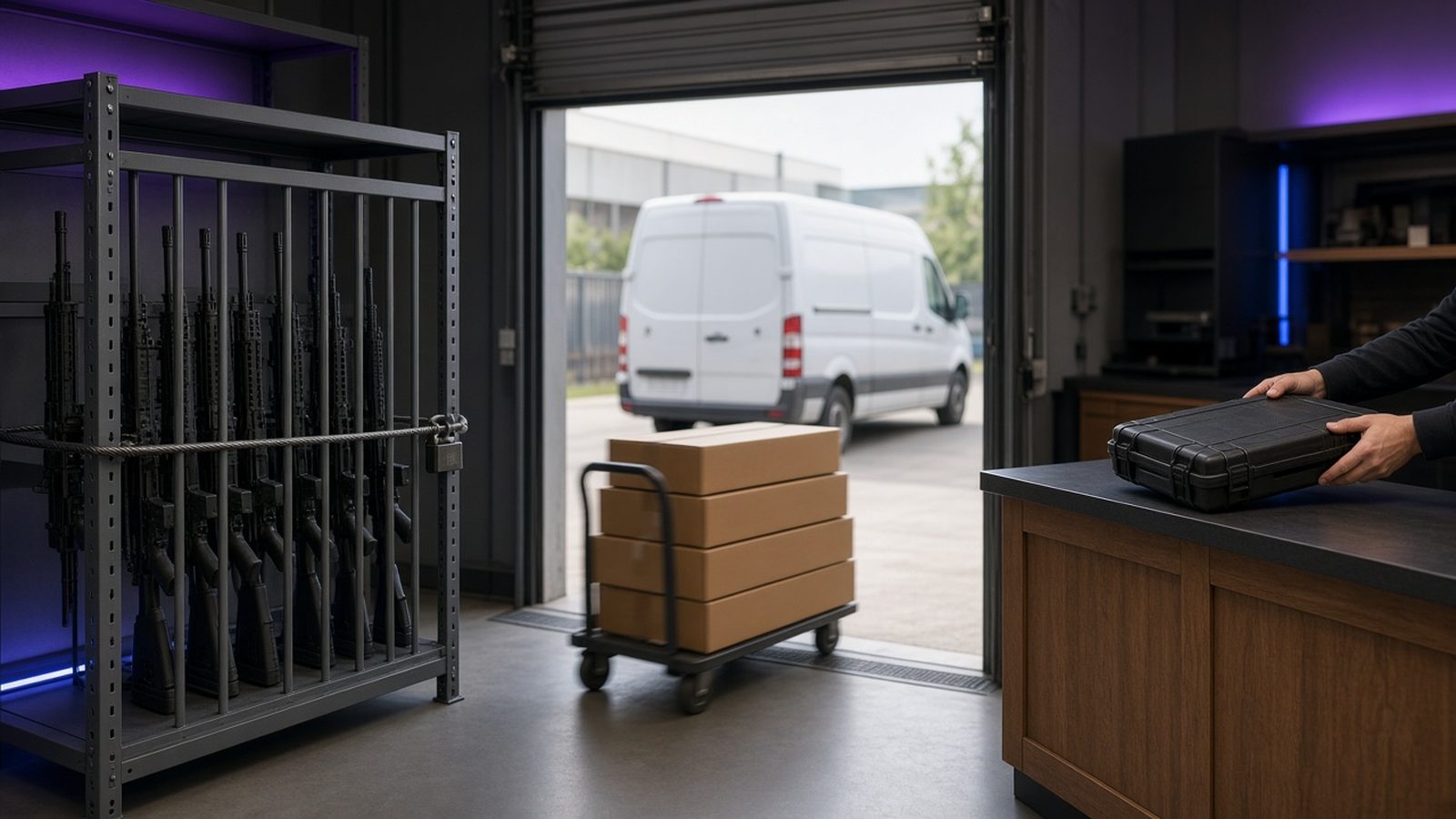
Should an online gun store stock inventory, drop-ship, or only do transfers? Each model can work, and many stores end up mixing them. The right choice depends on your cash, your space, how fast you want to ship, and how much paperwork you are ready to run. None of the three removes the need for a federal firearms license (FFL) or the records that come with it.
This is the fourth post in our getting-started series on selling firearms and ammo online. Earlier posts covered whether you need an FFL, how to get one, and when you need an SOT. This is general education, not legal advice. Confirm your setup with ATF, your state, and a firearms attorney.
The three models in plain terms
Stocking inventory. You buy firearms from distributors or manufacturers, receive them at your licensed premises, and ship each sale to the buyer’s chosen FFL. You control the product, the packing, and the ship date. You also carry the cost of the stock and the space to store it securely.
Drop-shipping. A distributor ships the firearm for you. In the setup ATF has described for licensees, the gun goes straight from the distributor to the receiving dealer, and your store never physically handles it. You list products from the distributor’s catalog and earn a margin, with little or no money tied up in stock.
Transfers only. You do not sell your own guns online at all. Buyers purchase from other online sellers and pick your shop as their receiving FFL. You receive the firearm, run the counter transfer with the buyer, and charge a transfer fee you set yourself.
What every model still requires
A few federal rules apply no matter which model you pick.
- License verification between dealers. Under 27 CFR 478.94, a licensee selling or disposing of firearms to another licensee has to verify the transferee’s identity and licensed status before the transaction. That is done with a certified copy of the transferee’s license, plus any other means the transferor thinks are needed. Our post on how to verify an FFL before you ship walks through it.
- A Form 4473 for sales to non-licensees. Under 27 CFR 478.124(a), a dealer can’t sell or otherwise dispose of a firearm to a person who isn’t a licensee without recording it on a Form 4473. In online sales, that counter paperwork normally happens at the receiving dealer.
- Acquisition and disposition (A&D) records. Under 27 CFR 478.125(e), each licensed dealer records each receipt and disposition of firearms. A purchase or other acquisition has to be entered no later than the close of the next business day. The entry shows the date of receipt, who it came from, the manufacturer and importer (if any), model, serial number, type, and caliber or gauge.
Stocking inventory: control at a cost
Stocking gives you the most control. You can photograph real items, check condition, bundle accessories, and ship the same day. You decide which carrier you use and how you pack.
The trade-offs are cash and work. Every gun you buy sits on your books until it sells. Every receipt and every sale goes in your A&D record. You need secure storage at your licensed premises, plus a plan for slow sellers. For a new store with limited capital, a large starting inventory is a real risk.
Stocking makes the most sense when you already have a storefront, a niche where you know what sells, or distributor pricing that rewards volume.
Drop-shipping: lower capital, shared control
Drop-shipping lets a new store list a wide catalog without buying it first. It is not paperwork-free. ATF has published guidance on drop shipments between licensees (ATF Procedure 75-3, also discussed in an ATF FFL Newsletter). In general terms, it describes a chain among three licensees:
- Your store (the middle licensee) takes the order.
- The distributor ships the firearm directly to the receiving licensee.
- The receiving licensee’s certified license copy has to reach the distributor before shipment.
- The distributor records the disposition to the receiving licensee, and the receiving licensee records the acquisition.
Under that guidance, the middle licensee does not take physical possession and keeps commercial records rather than an A&D entry for that gun. ATF has also said that someone brokering drop-shipped firearms needs an FFL. NFA items are excluded from this procedure. Read the current ATF text yourself before you build your process around it, and ask ATF or counsel about any edge case.
Distributors also set their own drop-ship rules. These can include matching the dealer’s premises address to ATF eZ Check, requiring signed FFL copies, excluding NFA items, and limiting shipping regions. Terms vary by distributor and change over time, so get each one’s current program rules in writing.
The trade-offs: thinner margins, less control over packing and timing, and catalog data that can go out of date. If a distributor sells out, you are the one who explains the delay to the buyer.
Transfers only: low risk, low ceiling
A transfers-only business is the simplest to start. You carry no firearm inventory for online sale, and income comes from fees and in-store sales. The receiving side still has real work. Each incoming gun goes in your A&D record, and each transfer to a buyer needs a 4473 and the background check process.
The limit is growth. Your volume depends on other sellers’ customers choosing you. Many shops use transfers as a way to bring people in the door while they build a stocked or drop-ship catalog.
How to choose
Ask these questions before you commit:
- How much money can you tie up in stock for 90 days or more?
- Do you have secure, licensed space to store and pack firearms?
- Do your distributors offer drop-ship programs, and what do their rules require from you and the receiving dealer?
- How will you keep your A&D record current at your order volume?
- Will you sell items that need special handling, such as NFA items, that drop-ship programs exclude?
A common mix is to drop-ship for breadth, stock your best sellers, and accept transfers for local traffic. If your catalog mixes firearms with items that ship to the door, see our guide to which products need an FFL.
Where Automatic FFL fits
Whatever model you choose, buyers of firearms still need to pick a receiving dealer at checkout. Automatic FFL adds FFL dealer selection to BigCommerce, WooCommerce, and Adobe Commerce / Magento checkouts (Shopify: ammunition only).
For drop-ship and fulfillment tools, Automatic FFL documents integrations with Flxpoint and Spark Shipping. With the integration setting turned on, orders can carry the selected dealer’s FFL license number, expiration, ATF eZ Check link, and certificate link when one is available. Flxpoint rules can also mark firearm and ammo products as FFL-required. See the documentation and our post on Spark Shipping for firearms merchants. Automatic FFL does not supply distributor catalogs, and it does not replace your own license verification or records.
Bottom line
Stock inventory if you want control and have the cash and space. Drop-ship if you want a wide catalog with less capital, and accept that the paperwork chain still runs between licensees. Do transfers only if you want the lowest-risk start. In every case you need an FFL, license verification between dealers, A&D records, and a 4473 at the counter.
Look up a transfer dealer for free. Create a free Automatic FFL account to search FFL dealers by license number, name, city, state, or ZIP, open each dealer’s ATF eZ Check record, and see which dealers have certificate data on file. The database is not legal advice and does not replace your own compliance review. → https://www.automaticffl.com/ffl-database/
Try Automatic FFL free for 30 days. Add FFL dealer selection to your BigCommerce, WooCommerce, or Adobe Commerce / Magento checkout (Shopify: ammunition only). Plans start at $99 per site per month after the trial; you’re not charged until the trial ends, and you can cancel before then. → https://www.automaticffl.com/pricing/