




Under-21 Handgun Sales After DOJ's Opinion: What FFL Dealers and Online Sellers Should Know
DOJ says it won’t prosecute dealers for selling handguns to law-abiding 18 to 20 year olds. ATF’s regulation, license risk, and state age laws have not moved.
Giancarlo Byrne
10/15/2026
In September 2026, the Justice Department’s Office of Legal Counsel (OLC) concluded that the federal rule barring licensed dealers from selling handguns to adults under 21 is unconstitutional as applied to 18 to 20 year olds. The story is back in the news this week, and dealers and online sellers are asking a fair question: can we sell handguns to 18, 19, and 20 year olds now?
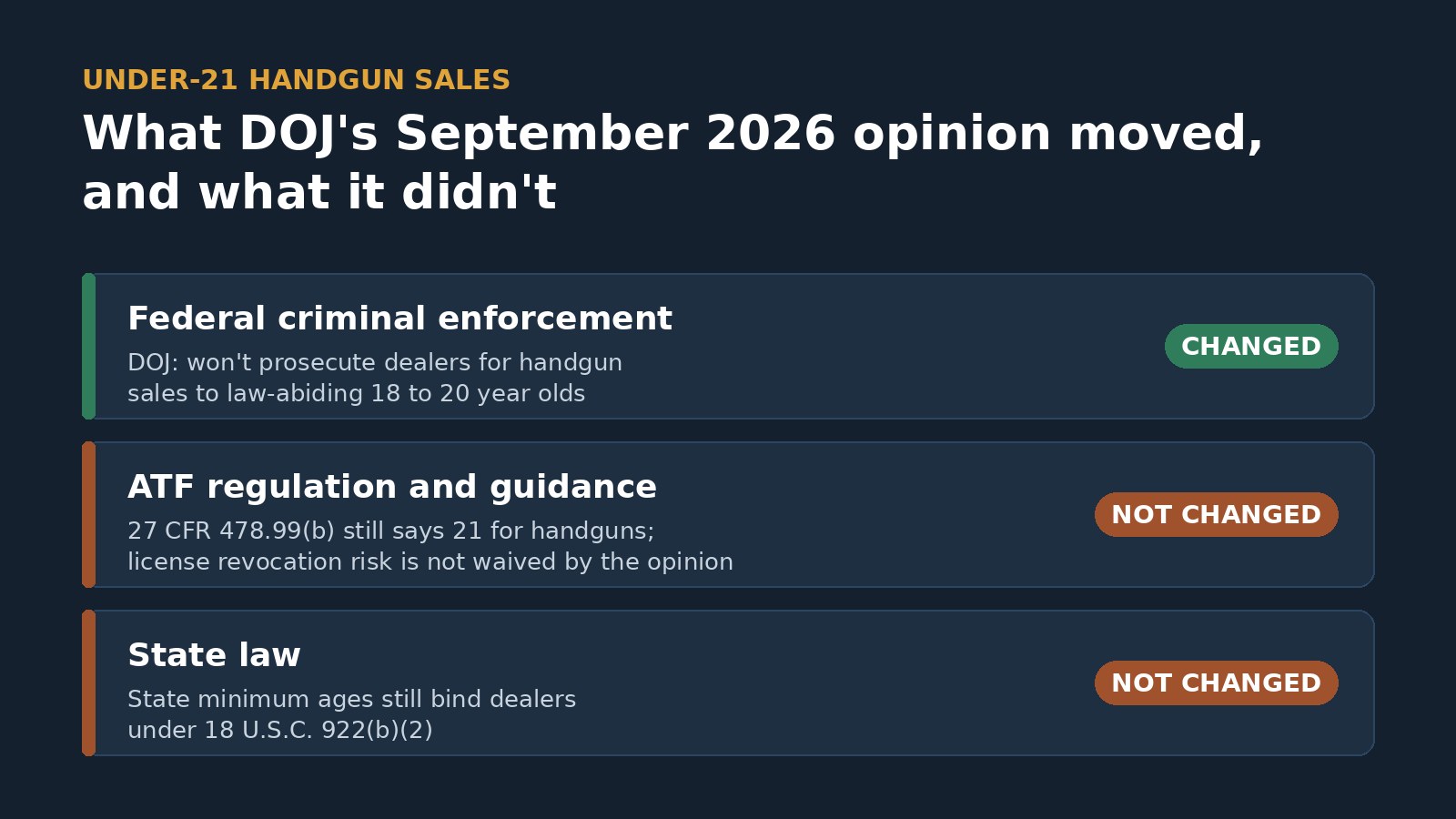
The short answer is that DOJ changed its criminal enforcement position, and that is all it changed. The statute, ATF’s regulation, license revocation risk, and state age laws are still there. This article walks through what the opinion says, what it leaves alone, and what it means for checkout age gates. It is general information, not legal advice.
What DOJ actually said
The opinion is titled Application of 18 U.S.C. § 922(b)(1) and (c)(1) to Young Adults. It is dated September 17, 2026, and DOJ announced it on September 18. Those two provisions set the federal age floor for dealer sales: 18 for rifles and shotguns and their ammunition, and 21 for everything else, including handguns.
The operative conclusion is narrow. OLC wrote that the provisions “may not be enforced to impose criminal penalties on dealers who sell handguns to a class of law-abiding adults who, in nearly every other relevant respect, are members of the political community.”
DOJ has started acting on that position. In Reese v. ATF, a case challenging the under-21 handgun rule, DOJ asked the court to declare the case moot because OLC “has now concluded that those restrictions are unconstitutional and ‘may not be enforced,’” according to reporting by The Reload. The plaintiffs are reportedly opposing that request and pursuing broader relief.
What the opinion does not cover
The limits matter as much as the headline:
- Handguns only. OLC says frames and receivers, silencers, destructive devices, and undetectable firearms are outside the scope of its opinion.
- Criminal penalties only. The opinion speaks to prosecuting dealers. It notes that anyone who willfully sells in violation of the age restrictions “risks losing that license” under 18 U.S.C. 923(e) and 27 CFR 478.73. It does not say ATF will forgo administrative action against a license.
- Not under 18. The opinion does not address sales to anyone under 18, the separate federal limits on juvenile handgun possession in 922(x), or the prohibited-person rules in 922(g).
- The extra NICS window still applies. The opinion does not touch the enhanced background check period for buyers under 21 in 922(t)(1)(C).
- Handgun ammunition is unclear. DOJ’s press release describes the statutes as covering “handguns or handgun ammunition.” The opinion’s conclusion speaks only to dealers who sell handguns. Treat handgun ammunition as unresolved.
What is still on the books
An OLC opinion sets DOJ’s legal position. It does not amend a statute or a regulation.
The statute. Congress has not changed 18 U.S.C. 922(b)(1). It still says a dealer may not sell a firearm other than a rifle or shotgun to someone it knows or has reason to believe is under 21.
The regulation. 27 CFR 478.99(b) still says the same thing, and it still covers handgun ammunition. OLC itself cites 478.99(b) as the current implementing rule.
ATF guidance. As of October 15, 2026, we have not found an ATF open letter, FAQ, or revised Form 4473 that implements the opinion. Check ATF directly for anything newer.
Reversibility. An enforcement position can be withdrawn. A future administration could take a different view, and a court ruling could change the picture in either direction.
State law still decides a lot
Federal law still ties dealer transfers to state law. Under 18 U.S.C. 922(b)(2) and 27 CFR 478.99(b)(2), a dealer can’t transfer a firearm where the buyer’s purchase or possession would violate state law or a published ordinance.
Several states set their own 21 floor. Two examples:
- California. The Attorney General’s firearms FAQ says that under Penal Code section 27510, a licensed dealer may not transfer any firearm to anyone under 21, except as specifically exempted, and the exemptions cover firearms that are not handguns.
- Florida. Florida Statutes 790.065(13) says a person younger than 21 may not purchase a firearm, and a licensed dealer may not make or facilitate that sale, with narrow exceptions for rifles and shotguns bought by certain law enforcement officers, correctional officers, and servicemembers.
Those rules are untouched by the DOJ opinion. Other states have their own age rules, so check the receiving dealer’s state before any transfer.
What this means for online sellers
For an online firearm order, the legally operative age check happens at the receiving dealer, on the Form 4473 with a NICS check. Your storefront age gate is a risk control that keeps orders from reaching a dealer who can’t complete them. Our earlier post on age verification for firearms covers how those steps fit together at checkout.
A few practical points:
- Don’t lower a nationwide handgun gate to 18 based on the opinion alone. ATF’s regulation still says 21, license risk is not waived, and many buyers live in states with their own 21 rule. Orders that can’t be transferred turn into cancellations and refunds.
- Keep handgun ammunition gates where they are for now. The opinion does not clearly cover ammunition.
- Keep frames and receivers at 21. They are outside the opinion’s scope.
- Separate product classes in your gates. Long guns and long-gun ammunition, handguns, handgun ammunition, and frames or receivers each follow different rules. A single store-wide age setting can be too strict for some items and too loose for others.
- Talk to your receiving dealers. Many dealers will keep a 21 policy for handguns until ATF updates its guidance. A shopper who passes your gate but is turned away at the counter is a bad experience for everyone.
- Get advice before changing policy. If you are considering selling or transferring handguns to 18 to 20 year olds, talk to a firearms attorney about federal license risk and the laws in each state you serve.
Automatic FFL lets shoppers choose their receiving dealer at checkout on BigCommerce, WooCommerce, and Magento, and on Shopify for ammunition only. It helps get the order to the right dealer. It does not decide whether a buyer is old enough or whether a sale is legal in a given state, and it does not replace the dealer’s transfer process. Setup details are in our documentation.
What to watch
- ATF guidance. An open letter, FAQ, regulation change, or Form 4473 update would be the clearest signal of how ATF plans to handle licenses.
- Reese v. ATF. Whether the court accepts DOJ’s mootness request, or grants broader relief, will shape how durable this is.
- Political pressure. On October 14, 174 House Democrats urged DOJ to reverse course. A letter changes no law, but it is a reminder that this position can be revisited.
- State action. Watch for states adding or adjusting their own age rules.
Sources
- DOJ Office of Legal Counsel: Application of 18 U.S.C. § 922(b)(1) and (c)(1) to Young Adults (Sept. 17, 2026)
- DOJ press release: Justice Department concludes federal ban on handgun sales to 18 to 20 year olds is unconstitutional (Sept. 18, 2026)
- 18 U.S.C. § 922 (Cornell LII)
- 27 CFR 478.99 (Cornell LII)
- California Attorney General: Firearms FAQ
- Florida Statutes 790.065 (2026)
- The Reload: DOJ moves to moot under-21 pistol sales challenge (Oct. 8, 2026)
- The Truth About Guns: 174 Democrats press DOJ on under-21 handgun sales (Oct. 14, 2026)
This article is general information, not legal advice. Check ATF’s current guidance and the laws of every state you serve, and consult a firearms attorney before changing who you sell or transfer handguns to.